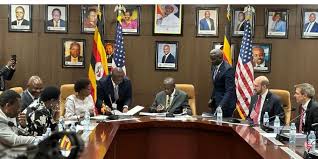


Uganda and the United States announced on Wednesday that they have signed a bilateral health cooperation agreement worth $2.3 billion, marking a major expansion of joint efforts to strengthen Uganda’s health system.
The deal forms part of the Trump administration’s “America First Global Health Strategy,” which encourages lower-income countries to shift from long-term aid dependence toward greater self-sufficiency in tackling infectious diseases.
Under the new Memorandum of Understanding, Uganda is set to receive up to $1.7 billion in U.S. funding over the next five years. The investment will support key health programmes focused on HIV/AIDS, tuberculosis, malaria, and other priority issues, while also bolstering the country’s health workforce and disease surveillance capabilities.
During the same period, the Ugandan government has committed to increasing its own health spending by more than $500 million, enabling it to “gradually assume greater financial responsibility” for its health sector, according to a joint statement.
The agreement aims to help Uganda build a resilient health system capable of preventing the spread of both emerging and established infectious diseases.
Uganda becomes the latest African nation to sign such a pact with the Trump administration, following similar agreements recently concluded with Kenya and Rwanda after the U.S. reduced foreign aid spending and scaled back USAID operations.