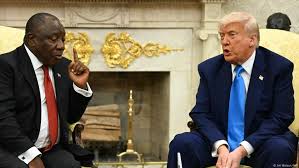


A meeting intended to ease tensions between the United States and South Africa took an unexpected turn as President Donald Trump confronted President Cyril Ramaphosa with allegations regarding the persecution and killings of white farmers in South Africa.
This occurred on Wednesday, just a week after the US granted asylum to nearly 60 Afrikaners, a decision that had already caused friction between the two nations.
During a live press conference, Trump caught Ramaphosa off guard by presenting widely debunked claims of a so-called ‘white genocide’ in South Africa.
He showcased a video that purportedly depicted burial sites for murdered white farmers, which he claimed were marked by crosses along a road.
However, these crosses were not actual graves; they were part of a 2020 protest in KwaZulu-Natal following the murder of a farming couple, intended to symbolize the ongoing violence against farmers.
Prior to the meeting, Ramaphosa had emphasized his focus on enhancing trade relations with the US, especially given the looming 30% tariff on South African exports once a suspension of Trump’s new import taxes concludes in July.
In an effort to win over Trump, Ramaphosa brought along two renowned South African golfers and presented him with an extensive book showcasing the country’s golf courses.
The meeting, which took place shortly after the arrival of 59 white South Africans granted refugee status in the US—whom Ramaphosa had previously labeled ‘cowards’—began on a positive note.
However, the atmosphere shifted dramatically when Trump requested dimmed lighting for a video presentation, which included a clip of prominent South African opposition leader Julius Malema singing a controversial song that incited violence against Afrikaners, further complicating the diplomatic dialogue.
During a meeting, he presented Ramaphosa with documents detailing incidents of violence against white individuals in South Africa.
Trump expressed his intention to seek clarification from Ramaphosa regarding allegations of white ‘genocide’ in the country, claims that have been largely discredited.
In response to the opposition’s chants captured in the video, Ramaphosa stated, ‘What you witnessed—the speeches made—do not reflect government policy.
South Africa operates under a multiparty democracy that permits diverse expressions.’ He emphasized that the government’s stance is entirely contrary to the views expressed by Malema, a leader of a minor opposition party that is constitutionally permitted to exist.
Ramaphosa expressed hope that Trump would heed the perspectives of South Africans on this matter, highlighting the presence of white members in his delegation, such as renowned golfers Ernie Els and Retief Goosen, as well as Johann Rupert, the wealthiest individual in South Africa.
‘If genocide were occurring, these three gentlemen would not be present,’ Ramaphosa remarked. Trump interjected, ‘However, you do permit land confiscation, and when that occurs, white farmers are killed, yet there are no repercussions for those responsible.’
Ramaphosa firmly replied, ‘No.’ The U.S. President seemed to allude to Malema and his Economic Freedom Fighters party, which, despite not being part of the government, is perceived to have the authority to seize land from white farmers, a claim that is inaccurate.
Earlier this year, Ramaphosa enacted a contentious law allowing the government to expropriate privately-owned land without compensation under certain conditions, although the South African government asserts that no land has yet been taken under this legislation.
Ramaphosa did acknowledge the existence of ‘criminality in our country,’ noting that individuals who fall victim to violent crime are not exclusively white, with the majority being black.
In reference to the crosses shown in the video, Trump remarked, ‘The farmers are not black. I do not imply that this is either good or bad, but the farmers are not black…’
South Africa does not publish statistics on racially motivated crimes; however, recent data indicates that nearly 10,000 murders occurred in the country from October to December 2024.
Among these, twelve fatalities were linked to farm attacks, including one farmer, five farm residents, and four employees, who were likely to be black.
In a discussion with reporters following a meeting at the Oval Office, President Ramaphosa expressed that while the topic of genocide claims was raised, he sensed skepticism in Trump’s perspective.
He expressed hope that the testimonies from other members of his delegation regarding their experiences in South Africa would provide clarity.
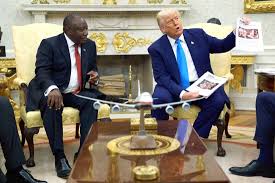
Ramaphosa emphasized his view of this as an ongoing dialogue and anticipated future meetings with Trump, particularly at the upcoming G20 summit in South Africa in November.
The narrative of genocide in South Africa has been a point of contention among right-wing factions for several years. In February, a South African judge dismissed these claims as ‘clearly imagined’ and ‘not real’ during a ruling related to a donation to a white supremacist organization.
While Trump continued to address the issue, Ramaphosa maintained his composure and attempted to lighten the mood with a humorous suggestion of providing a plane to the United States.
He also referenced the legacy of anti-apartheid leader Nelson Mandela, reaffirming South Africa’s dedication to racial reconciliation.