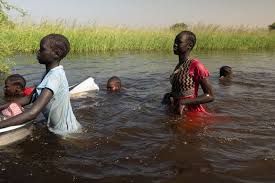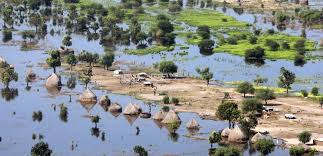


South Sudan’s seasonal flooding, which was once a regular occurrence, has escalated into a yearly disaster, displacing hundreds of thousands and exacerbating the crisis for many communities. Families like that of Nyabuot Reat Kuor, a mother forced from her home in Gorwai, are among those most affected by this climate emergency.
“In Gorwai, the flooding was overwhelming. It ruined our farm and displaced us permanently,” Nyabuot recounted. “We are unsure of the reasons behind this flooding, but it devastated our land and led to the loss of our livestock. After being uprooted from our home, we had to rely on wild plants for sustenance.”
Currently, Nyabuot and her family reside along the Jonglei Canal, an unfinished waterway that has become essential for over 69,000 displaced individuals in Ayod County. The villagers depend on food aid from the World Food Programme (WFP), as well as wild plants and water lilies from the swamp when supplies run low.
The U.N. humanitarian agency reports that this year alone, more than 379,000 individuals have been displaced due to flooding. The World Bank has labeled South Sudan as the most vulnerable nation to climate change, and the country is ill-prepared to manage such crises. With deteriorating infrastructure and the aftermath of years of civil conflict, the government struggles to respond to flooding, which continues to inundate villages, devastate agricultural land, and kill livestock.
The displaced populations in Ayod County find themselves nearly isolated from the outside world. Roads are traversable, and canals are too shallow for boats carrying essential supplies. Consequently, aid must be delivered by air.
“We actually deliver food by airdrops,” explained John Kimemia, a WFP airdrop coordinator. “Before we can drop supplies, we need to establish a drop zone. In this instance, the area lacked a clear drop zone, so we rely on the community to help clear it. Currently, there is no access by road or boat from the canal.”
Despite the efforts of the World Food Programme, resources are increasingly limited. In recent years, food aid rations have been reduced by half due to a decline in international funding. When this assistance ceases, displaced families are compelled to search for food on their own.
The isolation faced by these communities exacerbates their difficulties. In Pajiek, the county seat of Ayod, access requires a six-hour trek through waist-deep water. There is no mobile service, no government presence, and healthcare is irregular.
At the health center in Paguong village, which is surrounded by floodwaters, medical staff have not received payment since June. Patients, primarily women and children, sit on the ground awaiting treatment, all while being wary of venomous snakes in the vicinity.
South Sudan’s economic situation has deteriorated further due to a damaged oil pipeline in neighboring Sudan, a consequence of its ongoing civil conflict, which has disrupted exports. Civil servants throughout the nation have gone without pay for over a year.
The persistent flooding has been attributed to various factors, including the opening of dams upstream in Uganda and rising water levels in Lake Victoria. The Sudd wetlands in South Sudan have significantly expanded since the 1960s, leading to increased land submersion and displacement of populations.
As the situation deteriorates, the incomplete Jonglei Canal—a colonial-era initiative aimed at redirecting water north to Egypt—has become a refuge for families seeking higher ground.
However, for displaced individuals like Nyabuot Reat Kuor, existence remains uncertain. “We survive on what we can find,” she stated. “Wild plants, water lilies. We just want food and assistance to live.”
The flooding in South Sudan represents not only a climate crisis but also a humanitarian disaster, highlighting the vulnerabilities of a nation struggling with conflict, poverty, and environmental challenges. For Nyabuot and countless others, survival is precariously balanced.