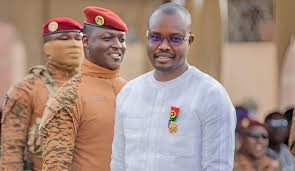


A day after disbanding the government without explanation, Burkina Faso’s military junta appointed a new prime minister on Saturday. Rimtalba Jean Emmanuel Ouedraogo, who served as the communications minister and spokesperson for the former administration, has been selected to lead the country.
The announcement was made by military leader Ibrahim Traore through a presidential decree broadcast on state television.
Ouedraogo, a journalist by profession and a close associate of Traore, previously held the positions of editor-in-chief and director of the national state television.
No justification was provided for the removal of former Prime Minister Apollinaire Joachim Kyelem de Tambela, who had been appointed as interim premier shortly after Traore took control in September 2022.
The junta overthrew Lieutenant Colonel Paul-Henri Sandaogo Damiba’s military regime approximately eight months after it had executed a coup to oust the democratically elected President Roch Marc Kaboré.
Burkina Faso is among several West African countries where military forces have recently seized power, taking advantage of widespread dissatisfaction with prior democratically elected governments regarding security challenges.
Since the recent coup, military leaders in Burkina Faso have faced significant challenges in addressing the country’s security issues, which they cited as the justification for their take over.
The rise in attacks by extremist groups affiliated with al-Qaeda and the Islamic State has wreaked havoc across the nation, resulting in thousands of fatalities in recent years and displacing over two million individuals, with children making up half of that number. Experts estimate that approximately half of Burkina Faso’s land remains beyond the control of the government.
The transitional government operates under a constitution ratified by a national assembly that includes military personnel, civil society representatives, and traditional and religious figures.
Under pressure from the Economic Community of West African States (ECOWAS), the junta initially aimed to hold elections in July 2024 to restore democratic governance.
However, in May, it announced an extension of its transitional period by an additional five years, equivalent to a full presidential term.
In conjunction with Niger and Mali, which have also undergone coups, Burkina Faso has cut ties with longstanding Western and regional allies, including ECOWAS, from which they all withdrew earlier this year.
These three nations have united to form the Alliance of Sahel States, working together to combat the jihadi violence that first emerged in northern Mali in 2012.