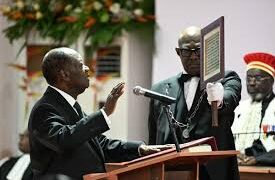


President Alassane Ouattara of Ivory Coast was sworn in Monday for his fourth five-year term, following an October election marked by low voter participation and severe restrictions on dissent. The ceremony drew several West African leaders, with heads of state from Mauritania, Liberia, Gambia, Ghana, Senegal, and Gabon in attendance.
During his inaugural address, Ouattara highlighted what he sees as the nation’s progress since he first assumed office in 2010. “On Saturday, October 25, Ivorians expressed their sovereign choice. They reaffirmed their commitment to democracy, to stability and to peace, for which so much effort has been made since 2011,” he said. He also warned of ongoing regional challenges, noting that the security environment remains fragile and that terrorist threats continue to evolve.
Now 83, Ouattara first rose to power after a disputed 2010 election against then-incumbent Laurent Gbagbo, a crisis that left at least 3,000 people dead before internationally backed forces helped install him. Supporters credit Ouattara with rebuilding a nation scarred by conflict and reviving its economy Africa’s largest cocoa producer while critics accuse him of entrenching his rule.
Tensions grew ahead of the October election when major opposition figures, including Tidjane Thiam and former president Laurent Gbagbo, were barred from running. Protests erupted after Ouattara announced his intention to seek a fourth term, and authorities eventually banned demonstrations altogether. Despite the ban, some protesters took to the streets, prompting police to fire tear gas and arrest hundreds.
Even so, many Ivorians view Ouattara as a stabilizing force who has overseen years of steady economic expansion, averaging 6% annual growth driven largely by a booming cocoa sector. Although the constitution previously limited presidents to two terms, Ouattara argued that a 2016 constitutional revision effectively reset his term count.
In recent years, he has also clashed with the military juntas ruling Niger, Mali, and Burkina Faso, which accuse him of aligning too closely with France tensions that reflect broader regional disputes over security and foreign influence.