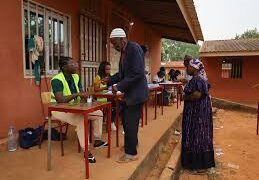


Ballot counting is in progress in Guinea-Bissau after citizens voted Sunday in presidential and legislative elections. President Umaro Sissoco Embaló is seeking a second term in a country long marked by political instability and recurrent coups.
The polls come at a tense moment for West Africa, where disputed elections and military takeovers in several nations have raised concerns about the future of democratic governance. Analysts say the race is tight between Embaló and Fernando Dias da Costa, a relatively unknown 47-year-old supported by former Prime Minister Domingos Simões Pereira, who finished second in the 2019 presidential race. A candidate must secure more than 50% of the vote to avoid a runoff.
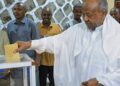
Embaló, who voted in Gabu, roughly 200 kilometers (124 miles) from the capital, urged citizens to participate. “I am the one who will serve a second term, and I hope that the electoral process will take place calmly and peacefully,” said the 53-year-old former army general, who first assumed power in 2021 with backing from a coalition of more than 20 political groups. He faces 11 challengers.
After casting his ballot, Dias da Costa accused the president of using heavy-handed tactics, warning that his party would not tolerate arrests or intimidation of supporters.
Pereira and the main opposition African Party for the Independence of Guinea and Cape Verde were excluded from the ballot after failing, authorities said, to submit their paperwork on time an omission that has intensified tensions around the vote. Nearly half of Guinea-Bissau’s 2.2 million people are registered voters.
Political analyst Augusto Nansambe called this one of the most contentious elections in recent memory, especially given the sidelining of the country’s largest opposition party. “The democracy we knew is no longer the model we are experiencing; we are experiencing a model defined by a single person,” he said.
Guinea-Bissau remains one of the world’s poorest nations, with half its population living in poverty, according to the World Bank. The country has also become a key transit point for drug trafficking between Latin America and Europe and has faced repeated coups and attempted coups since gaining independence from Portugal more than 50 years ago.
Election Shadowed by Uncertainty
Sunday’s vote follows yet another turbulent period. A coup attempt was reported in October, and the opposition has long argued that Embaló overstayed his mandate. Though Embaló won the November 2019 election and was sworn in three months later, the opposition challenged the results. The Supreme Court did not confirm his victory until September 2020. The court later ruled that his term should run until September 4 of this year, though elections were pushed to November.
The legislative contest is also unfolding under unusual circumstances. Parliament has been inactive since December 2023, when Embaló dissolved it following what he described as an attempted coup. The opposition particularly the party that won legislative elections in 2019 and 2023 has accused Embaló of undermining democratic institutions.
The Africa Center for Strategic Studies noted that beyond determining the next president, the vote will test Guinea-Bissau’s ability to strengthen its political institutions and curb executive overreach.
Competing Visions: Development vs. Stability
The campaign season was marred by allegations of corruption, violence and hate speech developments that could deepen national divisions, warned Denise dos Santos Indeque of the West Africa Network for Peacebuilding.
Embaló campaigned on infrastructure improvements, highlighting road construction and plans to modernize the main airport. Dias da Costa focused on restoring stability, safeguarding freedoms and improving security. He accused the government of widespread human rights abuses and urged voters to choose “change, national unity, reconciliation and peace, and an end to authoritarianism.”
In Bissau, resident Marinho Insoldé voiced cautious hope. “I hope that these elections will bring peace and tranquility so that there is no more hunger,” he said.