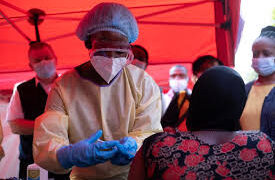


Uganda’s Ministry of Health, in partnership with the World Health Organization (WHO) and various collaborators, has initiated the inaugural vaccine trial for the Sudan strain of the Ebola virus, representing a crucial advancement in emergency vaccine research.
The trial is targeting healthcare workers and individuals who have been in contact with the Ebola strain, beginning just four days after the country reported the death of a nurse in Kampala.
The nurse had sought treatment at a hospital near the capital before traveling to Mbale in eastern Uganda, where he was subsequently admitted to a public facility. Health officials indicated that he also consulted a traditional healer. On Monday, two more cases were confirmed among the nurse’s family members.
Researchers from Makerere University and the Uganda Virus Research Institute (UVRI) have worked tirelessly to prepare for this trial within a mere four days following the outbreak confirmation on January 30. This trial is the first to assess the clinical efficacy of a vaccine specifically designed to combat Ebola caused by the Sudan virus.
The swift advancement was facilitated by a high level of research preparedness, while ensuring compliance with all national and international regulatory and ethical guidelines.
The candidate vaccine was supplied by IAVI, with financial backing from WHO, the Coalition for Epidemic Preparedness Innovations (CEPI), Canada’s International Development Research Centre (IDRC), and the European Commission’s Health Emergency Preparedness and Response Authority (HERA), along with assistance from the Africa Centers for Disease Control and Prevention (Africa CDC).
Dr. Tedros Adhanom Ghebreyesus, the Director-General of WHO, remarked, “This marks a crucial advancement in strengthening pandemic readiness and safeguarding lives during health crises. This success stems from the dedication of Uganda’s healthcare professionals, community engagement, and the joint efforts of the Ministry of Health, Makerere University, UVRI, and the comprehensive research network spearheaded by WHO. We extend our gratitude to our partners, including IAVI for their vaccine donation, CEPI, EU HERA, and Canada’s IDRC for their financial contributions, as well as Africa CDC for their support. This extraordinary achievement would not have been feasible without their collaboration.”
In 2022, amidst a prior outbreak of the Sudan strain of Ebola in Uganda, a randomized protocol for potential vaccines was established. The Ministry of Health has traced at least 234 contacts linked to this outbreak.
Health officials currently possess over 2,000 doses of a candidate vaccine for the Sudan strain, although the identity of the manufacturer remains undisclosed.
This outbreak is the first following the recent withdrawal of the Trump administration from the U.N. health agency and the subsequent suspension of foreign aid.
Uganda has faced multiple Ebola outbreaks, including a major incident in 2000 that led to numerous fatalities. Effective contact tracing is essential for managing the transmission of Ebola, which manifests as a viral hemorrhagic fever.
A trial vaccine known as rVSV-ZEBOV was previously administered to 3,000 individuals at risk during an outbreak of the Zaire strain of Ebola in eastern Congo from 2018 to 2020, proving effective in reducing the spread of the disease.
The emergence of Ebola in Uganda adds to a series of viral hemorrhagic fever outbreaks in the East African region, with Tanzania recently declaring an outbreak of the Ebola-like Marburg disease and Rwanda announcing the end of its own Marburg outbreak in December.