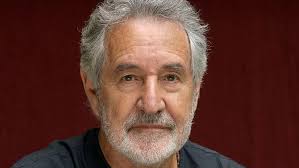


The esteemed anti-apartheid author and activist Breyten Breytenbach, who was imprisoned for his convictions in South Africa during the 1970s, has passed away at the age of 85, as confirmed by his family. He died peacefully in his sleep, with his wife Yolande present in Paris.
The dissident poet, novelist, and painter was described by his family as “an immense artist, militant against apartheid, who fought for a better world until the end.” Breytenbach’s keen intellect garnered him significant respect, leading the British satirical puppet show Spitting Image to refer to him as “the only nice South African” in a song during the bleakest periods of apartheid.
Jack Lang, a former French education minister, expressed his condolences on X, stating, “A rebel with a tender heart, he was part of all the struggles for human rights.”
Born on September 16, 1939, in the Western Cape to a family of five, Breytenbach spent much of his life abroad but remained deeply connected to his South African heritage. He studied at the University of Cape Town and became involved with a collective of Afrikaans poets and writers known as the Sestigers, who aimed to celebrate the beauty of their language while critiquing the oppressive apartheid system. Afrikaans, which developed among white settlers, derives its name from the Dutch term for African.
In an interview with The New York Times, he expressed, “I do not dismiss Afrikaans as a language; however, I reject its association with Afrikaner political identity. I no longer identify as an Afrikaner.”
In 1960, he departed from South Africa, entering a self-imposed exile primarily in Europe, where he remained a staunch critic of the apartheid regime while Afrikaners held power. He spent some time working in London before establishing his residence in France, where he met his Vietnamese spouse, Yolande Ngo Thi Hoang Lien.
Breytenbach attempted to return to South Africa with his wife during the 1960s, but her visa application was denied due to her being classified as “non-white,” as interracial marriages were prohibited by law. In 1975, at the peak of his literary acclaim, he made a secret return to South Africa, where he was apprehended for trying to support resistance movements within the country.
He received a seven-year prison sentence for terrorism but continued to compose poetry during his incarceration. In 1982, with the assistance of then French President François Mitterrand, he was released and subsequently became a French citizen.
The duration of his incarceration led to the creation of one of his most significant literary contributions, the novel The True Confessions of an Albino Terrorist, which provides a poignant narrative of his seven-year imprisonment, including two years spent in solitary confinement.
Following the end of apartheid regime in South Africa, he emerged as a prominent critic of Nelson Mandela’s liberation government, expressing his belief that the African National Congress (ANC) had devolved into a “corrupt organization.”
The poet utilized his writing not only to address injustices within South Africa but also to advocate for global issues. In 2002, he penned an open letter to then Israeli Prime Minister Ariel Sharon, published in The Guardian, questioning the international community’s silence regarding Israel’s actions. “Why should we look the other way when it is Israel committing crimes? A viable state cannot be built on the expulsion of another people who have as much claim to that territory as you have,” he articulated concerning the Israel-Palestine conflict.
Throughout his lifetime, Breytenbach authored over 50 books, many of which have been translated into various languages. He is also recognized for his surreal artwork, often portraying humans and animals in states of captivity. Later, he was honored as a Knight of the Order of Arts and Letters, France’s highest cultural distinction. Breytenbach is survived by his wife, Yolande, their daughter Daphnée, and two grandsons.