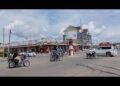
Rwandan-supported M23 rebels have taken control of Bukavu, the second-largest city in the eastern Democratic Republic of Congo, by occupying the regional governor’s office.
As the fighters entered the city center, some residents gathered along the streets to applaud and cheer them on, facing no opposition. This marks the second city, following Goma, to succumb to the rebels in the resource-rich area within recent weeks.
The Congolese government has confirmed the city’s capture and has advised residents to remain indoors “to avoid being targeted by the occupying forces.”
The United Nations and European nations have expressed concerns that this latest offensive, which has displaced hundreds of thousands, could lead to a broader regional conflict.
A Bukavu resident, who requested anonymity due to safety concerns, informed africa24hrsnews on Sunday that many individuals are still too frightened to venture outside.
“Since yesterday, children and young people have taken up arms. They are firing indiscriminately and looting,” she reported.
“This morning, the M23 entered and were welcomed by the people, who seemed very pleased to see them. We are unsure if this is due to fear or because they noticed the absence of any authorities in the city.
“The sound of gunfire can still be heard from where I live.”
On Friday, the M23 seized Bukavu’s main airport, located approximately 30 kilometers (18 miles) north of the city, and subsequently began their slow advance toward the city, which serves as the capital of South Kivu province.
Provincial governor Jean-Jacques Purusi Sadiki confirmed to Reuters that fighters had taken control of Bukavu city center by Sunday morning, noting that Congolese troops had retreated to prevent urban conflict.
This created a security void in the city on Saturday, leading to chaotic incidents, including a reported prison break from the central facility.
The UN World Food Programme (WFP) reported that a warehouse containing nearly 7,000 tonnes of food was looted.
Bukavu, a city of approximately two million residents located at the southern end of Lake Kivu, shares a border with Rwanda and serves as a crucial transit hub for the local mineral trade.
The capture of the city marks a significant territorial gain for the M23 since their recent insurgency began in late 2021, representing a setback for President Félix Tshisekedi’s government.
Government spokesman Patrick Muyaya accused Rwanda of infringing upon the territorial integrity of the Democratic Republic of Congo through expansionist actions and human rights violations.
The Congolese government alleges that Rwanda is instigating turmoil in the region and maintaining troops on the ground to exploit its natural resources, a claim that Kigali denies.
President Tshisekedi has called for sanctions against Rwandan President Paul Kagame in response to the recent unrest.
However, President Kagame has dismissed these threats, emphasizing that Rwanda’s primary concern is its own security.
He has expressed frustration over what he perceives as the Congolese authorities’ inability to address the threat posed by the FLDR rebel group based in the Democratic Republic of Congo.
The group consists of certain members of the Hutu militia, who have been implicated in the 1994 Rwandan genocide, during which approximately 800,000 individuals, predominantly from the Tutsi ethnic group, lost their lives over a span of more than 100 days.
On Sunday, troops from the Tutsi-led M23 assembled at the Place de l’Indépendance in central Bukavu. One of their commanders, Bernard Byamungu, was seen engaging with local residents and responding to their inquiries in Swahili.
He called on government forces, whom he claimed were “hiding in houses,” to surrender and accused the retreating military of instilling fear by arming local youth, who had embarked on a looting spree.
The African Union (AU), currently hosting a summit of heads of state in Ethiopia, reiterated its call for the M23 to disarm.
“We are all extremely concerned about the potential for an open regional conflict,” stated Bankole Adeo, the AU’s peace and security commissioner, as reported by Reuters.