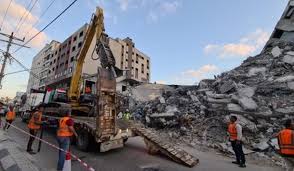


Egyptian Foreign Minister Badr Abdelatty announced on Sunday that the country has developed a reconstruction plan for Gaza that prioritizes the preservation of Palestinian residency on their land.
“We possess a comprehensive strategy for the reconstruction of the Gaza Strip that guarantees no individual will be forced from their homeland. Our intentions on this issue are unequivocal,” Abdelatty stated.
These remarks were made during a joint press conference in Cairo alongside Djibouti’s Foreign Minister Mahmoud Ali Youssouf, who was joined by Sudan’s Foreign Minister Ali Youssef Ahmed and UN Senior Humanitarian and Reconstruction Coordinator for Gaza, Sigrid Kaag.
Djibouti’s Foreign Minister expressed solidarity with Egypt’s position, praising President Abdel Fattah El-Sissi’s initiatives aimed at achieving a ceasefire.
He reiterated Abdelatty’s statements, highlighting the unified stance of the Arab nations.
Youssouf emphasized that a sustainable solution necessitates the creation of a Palestinian state that can coexist peacefully and securely with Israel, which he described as a fundamental and legitimate aspiration.
He categorically dismissed any proposals regarding the expulsion of Palestinians.
Abdelatty’s comments also indirectly countered US President Donald Trump’s suggestion that Egypt and Jordan should take in Palestinians from Gaza to “clean out the whole thing.”
Both Egypt and Jordan, along with other significant regional players such as Saudi Arabia, have rejected Trump’s proposal.
Abdelatty indicated that Egypt is prepared to host a conference focused on reconstruction, underscoring that rebuilding Gaza is essential for advancing the conflict resolution process through a two-state solution.
“We have a definitive reconstruction plan that does not entail displacing anyone from their land,” he affirmed. “This initial step will facilitate a credible political process aimed at establishing a Palestinian state, thereby helping to end the cycle of violence and hostility.”
Abdelatty emphasized that the only viable approach is to commence a political process aligned with international resolutions.
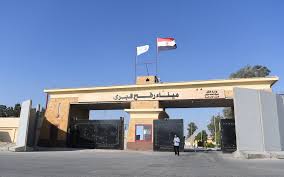
On Sunday morning, trucks were seen operating at the Rafah border crossing as the ceasefire agreement between Hamas and Israel continued to advance.
Palestinian health officials in Gaza announced that the Rafah border crossing with Egypt, which had been closed for an extended period, reopened on Saturday, enabling thousands of Palestinians in critical need of medical care to pass through.
Israeli forces had shut down the Rafah crossing in early May after gaining control during an offensive in the southern city, prompting Egypt to close its side of the crossing as well.
The reopening of the Rafah crossing represents a crucial development that reinforces the ceasefire agreement established between Israel and Hamas earlier this month.
Israel’s decision to reopen the crossing followed Hamas’s release of the last remaining female hostages in Gaza. Rafah is the only crossing for Gaza that does not connect to Israel.
The initial six-week truce includes provisions for the release of 33 hostages and nearly 2,000 prisoners, the return of Palestinians to northern Gaza, and an increase in humanitarian aid to the severely impacted region.
In the coming week, discussions are anticipated between Israel and Hamas regarding a second phase of the ceasefire, which aims to facilitate the release of the remaining hostages and extend the truce indefinitely. Should no agreement be reached, the conflict may resume in early March.