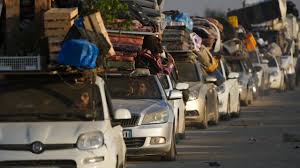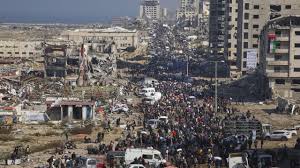


For the third consecutive day, thousands of displaced Palestinians were observed on Wednesday making their way back to the remnants of their homes in northern Gaza.
However, this moment of joy is likely to be fleeting, as they transition from one disaster zone to another. Months of relentless Israeli bombardment have devastated large areas of the enclave.
Suad Saleh, who is wheelchair-bound, expressed that the day the ceasefire was announced was the hardest of her life. “On that day, I realized my home was gone. Where will I go? To a tent. From one tent to another,” she lamented.
“Our suffering is immense, far beyond what anyone can comprehend. No one can truly understand it,” she stated after reaching her ruined home in Gaza City.
Despite the challenges, long lines of people were seen traveling north along Gaza’s coastal road on Wednesday, utilizing cars, motorbikes, donkey carts, or simply walking.
They carried whatever remnants of their belongings they could salvage after 15 months of being displaced within the enclave to avoid the conflict.
Yet, they face daunting challenges ahead amid the winter chill in Gaza, confronting the harsh realities of destroyed homes, severe food shortages, lack of running water, and no electricity.
The United Nations announced on Wednesday that more than 376,000 Palestinians have arrived in northern Gaza following the withdrawal of Israeli forces on Monday.
This movement aligns with the 42-day ceasefire agreement established to halt the Israel-Hamas conflict.
The conflict escalated after Hamas launched an attack on Israel on October 7, 2023, resulting in approximately 1,200 fatalities and 251 individuals being taken hostage and returned to Gaza.
According to Palestinian health officials, Israel’s subsequent military operations have led to the deaths of over 47,200 Palestinians, the majority of whom were civilians.