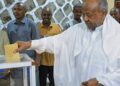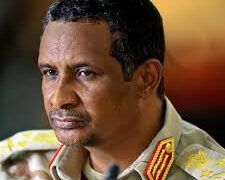


Sudan’s paramilitary group, the Rapid Support Forces (RSF), has declared the establishment of a competing government, two years after the nation plunged into a devastating conflict that has resulted in tens of thousands of fatalities and triggered what the United Nations describes as the worst humanitarian crisis globally.
Led by Mohamed Hamdan Dagalo, commonly known as Hemedti, the RSF announced the formation of the “Government of Peace and Unity” on Tuesday in regions under its jurisdiction. This action directly opposes the military-led government overseen by General Abdel Fattah al-Burhan.
“On this significant anniversary, we proudly announce the creation of the Government of Peace and Unity, a comprehensive coalition that embodies the true essence of Sudan,” Dagalo stated via Telegram.
Earlier, in February, the RSF and its partners had signed a charter in Nairobi, outlining their plans to establish an alternative governing body.
Dagalo mentioned that they have now ratified a transitional constitution, which he referred to as a “blueprint for a new Sudan.” This document suggests the formation of a 15-member presidential council that would represent all regions of the country.
Experts have consistently warned that the ongoing conflict poses a risk of permanently dividing Sudan. Sharath Srinivasan, a Sudan expert at the University of Cambridge, informed AFP that the RSF’s stronghold in Darfur could lead to a “de facto separation.”
Since the outbreak of war on April 15, 2023, nearly 13 million individuals have been displaced, with no political resolution in sight. The violence erupted following months of escalating tensions between Sudan’s military and the RSF, which were once allies that jointly executed the 2021 coup that disrupted a civilian-led transition.
As the RSF aims to strengthen its grip on western Sudan, the paramilitary group and its allied militias are
facing increased international scrutiny regarding their actions during the conflict.
On Tuesday, the United States condemned the Rapid Support Forces (RSF) for their recent assaults on civilians in and around the Zamzam and Abu Shouk camps, which shelter hundreds of thousands of displaced individuals in North Darfur.
According to the United Nations, the RSF’s attacks on these camps over the weekend resulted in the deaths of at least 300 civilians.
US State Department spokesperson Tammy Bruce expressed deep concern over reports indicating that the RSF has intentionally targeted both civilians and humanitarian workers. She urged all involved parties to adhere to international humanitarian law and to be held accountable for any violations.
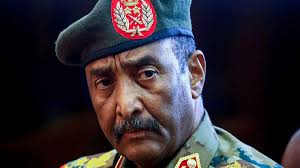
As the humanitarian situation in Sudan worsens, the United Kingdom organized a donor conference in London, where international partners committed to increasing their support.
The European Union pledged more than $592 million, while the UK announced an additional $158 million in aid.
“We require patient diplomacy,” stated UK Home Secretary David Lammy. “We cannot accept that conflict is inevitable. We must not find ourselves in the same situation a year from now.”
The military-aligned government of Sudan criticized the conference, pointing out that no representatives from either faction were invited to participate.
The co-chairs of the conference made a collective appeal for an immediate ceasefire and a shift towards civilian governance, emphasizing the need to prevent the division of Sudan and to keep external influences at bay.