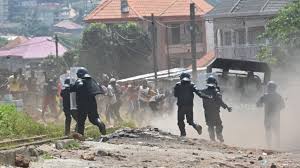


In a violent clash in Chad, at least 19 individuals have lost their lives following an intervention by security forces aimed at preventing armed assailants from attacking the presidential complex in N’Djamena.
According to government reports, 18 out of the 24 assailants were killed during the unsuccessful assault on the president’s office on Wednesday evening, with one security personnel also perishing in the conflict.
The foreign minister of Chad reassured citizens that the military was safeguarding the president and that the situation was stable. Residents in N’Djamena reported hearing a series of gunshots for several minutes in the vicinity of the presidential compound.
“Eighteen attackers were neutralized, and six others were injured, while we suffered one fatality and three injuries, one of which is serious,” stated Abderaman Koulamallah, Chad’s foreign minister and government spokesperson.
Following the incident, Koulamallah appeared in a video alongside soldiers, with a weapon at his side, declaring, “The situation is completely under control… the attempt to destabilize has been successfully countered.”
This attack coincided with an official visit from China’s Foreign Minister Wang Yi to Chad. Just hours prior to the outbreak of violence, Wang Yi had met with Chad’s President Mahamat Idriss Deby and other senior officials.
Koulamallah confirmed that Deby was present in the presidential complex during the assault.
Local resident Zakaria Daoud voiced his worries regarding the security conditions in a region notorious for its recurrent coups.
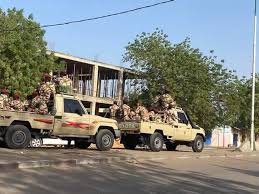
Video footage from the vicinity depicted military vehicles and heavily armed soldiers patrolling the streets and positioned around the presidential palace.
Foreign Affairs Minister Abderaman Koulamallah, appearing in a live broadcast on Facebook alongside military personnel, asserted, “The situation is entirely under control, and there is no cause for alarm.”
He reiterated their dedication to protecting the president. This event took place approximately one week after parliamentary elections intended to restore democracy, which the primary opposition chose to boycott.
The results of the elections are still awaited, and analysts suggest that the outcome could reinforce President Mahamat Deby Itno’s grip on power.
Deby Itno ascended to power as a military leader following his father’s death, who had ruled for three decades, during a conflict with rebels in 2021.
He was elected president last year in a vote that international observers criticized for its lack of credibility.