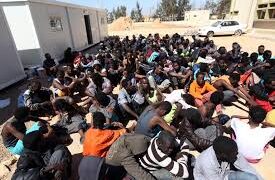


Libyan military authorities have reported the detention of hundreds of migrants navigating the expansive desert in hopes of eventually crossing the Mediterranean Sea to seek a better life in Europe.
The 444th Brigade, a significant militia operating under the Libyan army’s command, announced in a statement that its patrol leaders apprehended over 300 migrants and subsequently handed them over to the relevant authorities.
This information was shared via a Facebook post made available to africa24hrsnews, in which the group denounced smuggling and human trafficking, asserting that their patrols would persist in efforts to disrupt smuggling routes. The post included satellite imagery of the desert and photographs depicting migrants seated in rows before armed and masked individuals.
These apprehensions occur as Libya continues to serve as a major departure point for individuals from the Middle East and Africa seeking to reach Europe. Many of these individuals are fleeing conflict or poverty, often relying on smugglers to navigate perilous desert and maritime routes. According to the United Nations refugee agency, UNHCR, approximately 38,000 individuals have arrived in Italy and Malta from Libya this year.
The overcrowded vessels utilized by migrants and smugglers are frequently known to capsize, prompting European leaders to prioritize efforts in persuading North African nations to curb the flow of migrants attempting to reach the sea. However, unlike Morocco and Tunisia—where numerous migrants also seek passage to the southern coasts of Europe—the ongoing conflict between rival governments in Libya presents additional obstacles to effective migration management partnerships.

Volker Türk U.N. High Commissioner for Human Rights
Reports of migrant apprehensions in Libya are infrequent; however, the state news agency, LANA, indicated that over 2,000 arrests occurred in July. The oil-rich nation has descended into chaos following a NATO-supported uprising that ousted long-time dictator Moammar Gadhafi. Since that time, Libya has been fragmented between competing governments in the east and west, each supported by various militias and foreign entities. Human traffickers have exploited the prevailing political instability for years.
In July, U.N. High Commissioner for Human Rights Volker Türk stated that migrants in Libya have faced torture, forced labor, and starvation while in detention.