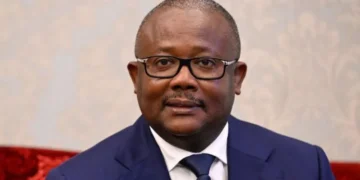


Guinea-Bissau’s ousted president, Umaro Sissoco Embaló, has arrived in Senegal after being released by the military junta that removed him from power earlier this week, Senegalese authorities confirmed.
His evacuation followed negotiations led by the West African regional bloc Ecowas amid escalating tensions in Guinea-Bissau. Senegal’s foreign ministry said Embaló landed “safe and sound” late Thursday aboard a chartered military aircraft.
Meanwhile, Guinea-Bissau’s military has installed Gen Horta N’Tam as transitional leader for a one-year period. The coup unfolded on Wednesday, just one day before officials were expected to announce provisional results from presidential and parliamentary elections. The army has halted the electoral process and blocked the release of results.
Military leaders claim they intervened to stop an alleged plot by unnamed politicians, whom they say were backed by a “well-known drug baron,” and have imposed a night-time curfew. Several political figures, including Embaló’s rival Fernando Dias, former Prime Minister Domingos Pereira, and Interior Minister Botché Candé, were reportedly detained.
Speaking to Reporters, Sierra Leone’s Foreign Affairs Minister Timothy Musa Kabba declined to comment on Embaló’s physical condition but said ensuring his safe extraction was the top priority. Sierra Leone’s President Julius Maada Bio, who chairs Ecowas, had contacted Guinea-Bissau’s military on Wednesday to secure assurances for the former president’s protection.
The streets of Bissau remained tense on Thursday, with shops and markets closed as soldiers patrolled the city. After Gen N’Tam’s swearing-in, the military reopened land, air, and sea borders that had been sealed during the coup announcement.
Some civil society groups and opposition figures have accused Embaló of staging a “simulated coup” to prevent election results from being released in case he lost. Dias, who also claimed victory in Sunday’s vote, labelled the military takeover an “organised coup” and insisted he won about 52% of the ballots. Embaló has not responded to the allegations.
Ecowas has suspended Guinea-Bissau from all its decision-making bodies until constitutional order is restored, condemning the military’s actions as a serious breach of democratic norms. The African Union and the United Nations have likewise called for the immediate restoration of constitutional rule.
Guinea-Bissau has experienced at least nine coups or attempted coups since gaining independence in 1974, cementing its reputation as one of West Africa’s most politically unstable nations.