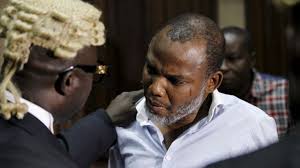


A Federal High Court in Abuja has found separatist leader Nnamdi Kanu guilty of terrorism, treason, and other charges, concluding a decade-long legal battle that has gripped Nigeria.
Justice James Omotosho sentenced Kanu to four concurrent life terms, rejecting prosecution calls for the death penalty. In his ruling, the judge said executions were now “frowned upon” and emphasized that Kanu’s broadcasts had incited violence and killings in pursuit of a separate Biafran state.
Kanu, who faced seven charges in total, was convicted of terrorism, treason, and involvement with the banned Indigenous People of Biafra (IPOB). He denied all allegations, challenged the court’s jurisdiction, and refused to defend himself after dismissing his lawyers. He was absent when the verdict was delivered, having been removed earlier for unruly behavior.
Security was heightened around the courthouse in Abuja ahead of the ruling, amid concerns of protests by Kanu’s supporters. Despite his popularity in south-eastern Nigeria, where IPOB has its strongest base, reaction to the verdict has so far been subdued.
Kanu first gained prominence in 2009 when he launched Radio Biafra, broadcasting calls for Igbo independence from London. Born in south-eastern Nigeria, he studied at the University of Nsukka before moving to the UK, where he obtained British citizenship.
In 2014, he founded IPOB, which was banned in 2017 and designated a terrorist organization. Its armed wing, the Eastern Security Network, has since been accused of violent attacks.
Kanu was first arrested in 2015 but fled Nigeria in 2017 after a military raid on his home, leading to the revocation of his bail. He was re-arrested in 2021 under disputed circumstances his lawyers claim he was detained in Kenya and forcibly returned, though Kenyan authorities have not commented.
In 2022, an appeal court dismissed the charges, ruling his arrest abroad illegal, but the Supreme Court overturned that decision in 2023, paving the way for his conviction.
The push for Biafran independence dates back to 1967, when Igbo leaders declared a separate state. The ensuing civil war claimed up to a million lives before the rebellion was crushed. While many Igbo people continue to feel marginalized within Nigeria, support for secession remains divided.


