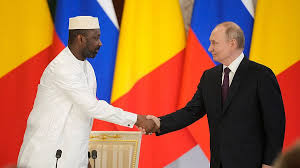


Mali and Russia have signed a series of agreements aimed at strengthening their economic and trade relationship, including a notable pact on the peaceful use of nuclear energy. The signing took place during Malian interim president Assimi Goïta’s official five-day visit to Moscow, where he met with Russian President Vladimir Putin.
Among the key outcomes was the establishment of a new Intergovernmental Commission for Trade, Economic, Scientific, and Technical Cooperation a platform both leaders hope will drive growth across sectors such as natural resources, energy, and logistics.
President Putin acknowledged that while trade volumes between the two nations remain modest, they are improving and ripe with potential. Mali’s leader echoed that sentiment, emphasizing the trust and effectiveness defining their partnership.

The visit follows the withdrawal of the controversial Wagner paramilitary group from Mali, which has now been replaced by the Russian state-backed Africa Corps. The shift signals a new phase in Russia’s involvement in Mali and the broader Sahel region, where countries increasingly look to Moscow for military and logistical support in fighting jihadist insurgencies.
Mali has recently seen a spike in attacks by militant groups, including a deadly raid by al-Qaeda-linked JNIM that claimed the lives of dozens of soldiers. The agreements with Russia come as part of broader efforts by Mali and its Sahel allies to secure stability and rebuild vital infrastructure under intense pressure.


