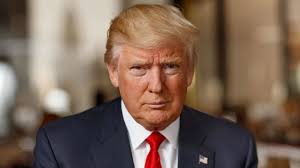


U.S. President Donald Trump has announced his intention to terminate all financial support to South Africa and has initiated an inquiry into the nation’s policies, alleging that a significant human rights violation against white individuals is occurring due to a new land expropriation law.
On his Truth Social platform, Trump stated on Sunday, “South Africa is seizing land and treating certain groups of people VERY BADLY.”
He asserted that a “massive Human Rights VIOLATION, at a minimum, is happening for all to see” in South Africa, although he did not provide specific details or evidence to support his claims.
“The United States won’t tolerate this; we will take action,” Trump declared. “Furthermore, I will be halting all future funding to South Africa until a comprehensive investigation into this matter is conducted!”
In response, the South African government remarked on Monday that the Trump administration should gain a clearer understanding of the new law, which aims to address the repercussions of decades of white minority governance during the apartheid era, which concluded in 1994. South African President Cyril Ramaphosa emphasized in a statement that “the South African government has not confiscated any land.” Since the law’s enactment, no significant measures have been implemented.
During apartheid, land was appropriated from the Black majority in South Africa, who were relegated to living in areas designated exclusively for Black individuals. The law has been under discussion for years as a means to rectify historical injustices, according to the government.
Elon Musk, a close ally of Trump, who was born and raised in South Africa, has also criticized Ramaphosa’s administration, previously accusing it of being anti-white and asserting in 2023 that it was permitting a “genocide” against white farmers.
Experts in South Africa indicate that while incidents of violence against white farmers do occur, they are indicative of the country’s alarmingly high overall violent crime rates, which rank among the worst globally.
In remarks to the media, Trump stated on Sunday, “they’re taking away land, they’re confiscating land and actually they’re doing things that are perhaps far worse than that.”
Trump did not specify the particular policy he was referencing or the individuals affected. However, his statements seemed to respond to the recent land legislation enacted in South Africa, which allows the government to acquire land from private owners if deemed necessary for the public good.
This law has faced criticism from various groups within South Africa, who argue that it paves the way for the expropriation of land from the country’s white minority.
Nevertheless, the government asserts that individuals’ rights remain safeguarded, and land can only be appropriated under specific conditions where it is not being utilized productively and where redistribution serves the public interest. The race of the landowner is not a consideration in this process.
Ramaphosa’s office issued a statement on Monday, clarifying: “The recently adopted Expropriation Act is not a confiscation instrument, but a constitutionally mandated legal process that ensures public access to land in an equitable and just manner as guided by the constitution.”
South Africa, similar to the United States and various other nations, has historically implemented expropriation laws designed to reconcile the necessity for public land use with the safeguarding of property owners’ rights.
South African Foreign Minister Ronald Lamola emphasized that the Trump administration should utilize its announced investigation to enhance its comprehension of South Africa’s policies as a constitutional democracy. He noted that such understanding would promote a respectful and well-informed engagement with the country’s democratic principles.
South Africa significantly benefits from U.S. funding through the President’s Emergency Plan for AIDS Relief (PEPFAR), which allocates approximately $400 million annually to support the nation’s HIV/AIDS initiatives. This funding faced potential jeopardy following Trump’s decision to freeze foreign aid globally.
According to Ramaphosa’s office, there is “no other significant funding that is provided by the United States in South Africa,” despite the fact that South Africa is the largest trading partner of the U.S. in Africa, as reported by the U.S. International Trade Commission.
A civil society organization representing the interests of South Africa’s Afrikaans-speaking white minority, which has opposed the new legislation, stated that Trump’s proposed actions could adversely affect the South African populace. The group urged Trump to ensure that any “punitive measures” are directed at senior government officials.
Trump has previously criticized the South African government, notably in a 2018 social media post during his first term, where he claimed that land was being confiscated from white farmers and that there was a “large scale killing of farmers.” This statement was met with widespread condemnation in South Africa for its inaccuracies, prompting Trump to instruct then-U.S. Secretary of State Mike Pompeo to investigate.
Official crime statistics indicate that South Africa experiences an average of around 70 homicides daily, with the overwhelming majority of victims being Black.