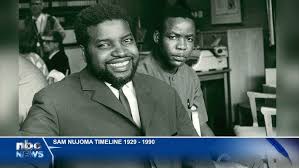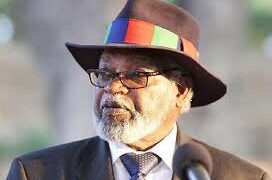


Sam Nujoma, the passionate freedom fighter with a distinctive white beard who guided Namibia to independence from apartheid South Africa in 1990 and served as its inaugural president for 15 years, has passed away at the age of 95. He was widely regarded as the father of the nation.
The announcement of Nujoma’s death was made on Sunday by the current Namibian President, Nangolo Mbumba, who reported that Nujoma had died on Saturday night after being hospitalized in Windhoek, the capital.
Mbumba stated, “The foundations of the Republic of Namibia have been shaken. Over the past three weeks, the Founding President of the Republic of Namibia and the Founding Father of the Namibian Nation was hospitalized for medical treatment and observation due to health issues.”
“Regrettably, this time, our most valiant son could not overcome his illness,” Mbumba continued.
He emphasized that Nujoma “led the Namibian people during the darkest moments of our liberation struggle.”
In his homeland, characterized by arid landscapes and sparse population, Nujoma was celebrated as a charismatic leader who guided the nation toward democracy and stability following a long period of colonial rule by Germany and a protracted war of independence against South Africa.
Nujoma spent nearly three decades in exile as the head of the independence movement before returning for the first democratic parliamentary elections in late 1989. He was subsequently elected president by lawmakers in 1990, marking the official confirmation of Namibia’s independence.
He was the last of a generation of African leaders who liberated their nations from colonial or minority rule, joining the ranks of notable figures such as Nelson Mandela of South Africa, Robert Mugabe of Zimbabwe, Kenneth Kaunda of Zambia, Julius Nyerere of Tanzania, and Samora Machel of Mozambique.
Many Namibians attribute the process of national healing and reconciliation following the divisive independence war and South Africa’s policies of ethnic segregation to Nujoma’s leadership.
Nujoma received commendations even from his political adversaries, despite being labeled a Marxist and facing accusations of harshly suppressing dissent during his time in exile. He was recognized for his role in crafting a democratic Constitution and for incorporating white business leaders and politicians into the government following Namibia’s independence.
While he demonstrated pragmatism and focused on nation-building domestically, Nujoma frequently made international headlines due to his vehement anti-Western statements. At a United Nations conference in Geneva in 2000, he shocked attendees by asserting that AIDS was a man-made biological weapon. He also engaged in verbal confrontations regarding homosexuality, referring to gay individuals as “idiots” and denouncing homosexuality as a “foreign and corrupt ideology.”
In a controversial move, he prohibited all foreign television broadcasts, claiming they had a detrimental effect on Namibia’s youth.
Nujoma fostered relationships with countries such as North Korea, Cuba, Russia, and China, which had previously supported Namibia’s liberation efforts through arms and training.
However, he also sought to maintain connections with Western nations, becoming the first African leader to be welcomed at the White House by former U.S. President Bill Clinton in 1993. Clinton praised Nujoma as “the George Washington of his country” and “a genuine hero of the world’s movement toward democracy.”
Additionally, Nujoma championed the empowerment of women in a predominantly patriarchal society, asserting that “there is no shortage of competent and experienced African women to lead the way forward.” Namibia recently elected its first female president, with President-elect Netumbo Nandi-Ndaitwah set to begin her term next month.
Nujoma’s upbringing was marked by poverty, being the eldest of 11 siblings in a rural family. His early years were spent tending to his parents’ cattle and farming. He attended a mission school before relocating to Windhoek, where he worked for South African Railways.
He was apprehended after a political demonstration in 1959 and subsequently fled the region shortly after his release, seeking refuge in Tanzania. While in exile, he played a pivotal role in founding the South West African People’s Organization (SWAPO) and was appointed its president in 1960. Since 1990, SWAPO has been the ruling party in Namibia, with Nujoma at the helm for 47 years until he stepped down in 2007.
In 1966, when South Africa ignored a U.N. resolution that called for the end of its mandate over the former German colony of South West Africa, Nujoma initiated SWAPO’s guerrilla warfare campaign.
“We commenced the armed struggle with merely two sub-machine guns and two pistols,” Nujoma recounted. “I acquired them from Algeria, along with some ammunition.”
Although SWAPO did not achieve a military victory in the independence struggle that spanned over two decades, Nujoma garnered significant political backing during his time in exile, which led to the U.N. recognizing SWAPO as the sole representative of the Namibian populace and ultimately prompted South Africa to withdraw from the nation.
While engaging with global leaders, Nujoma was conscious of his limited formal education. He left school at an early age to enter the workforce and later attended night classes to enhance his English skills. He dedicated his life to the liberation of his country instead.