

West African leaders have dismissed a transition roadmap announced by Guinea-Bissau’s military authorities, insisting on a rapid restoration of constitutional governance and cautioning that targeted sanctions could be imposed on individuals obstructing the process.
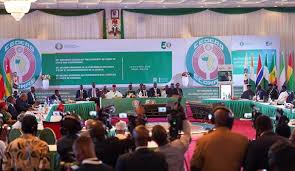
The stance was reiterated on Sunday in Abuja, Nigeria, during the 68th summit of the Economic Community of West African States (ECOWAS), as regional leaders gathered against a backdrop of rising insecurity, economic strain and political instability across West Africa.
In his opening remarks, ECOWAS Commission Chairman and President of Sierra Leone, Julius Maada Bio, warned that the return of unconstitutional changes of government poses a growing threat to peace and stability in the region.
“The founders of ECOWAS recognized that democracy, peace, justice and development are inseparable,” Bio said. “That democratic order is now under strain. Unconstitutional seizures of power undermine regional stability, erode citizens’ rights and weaken our shared future.”
He cited the ongoing political uncertainty in Guinea-Bissau and a recent attempted coup in Benin as evidence that democracy in West Africa requires sustained vigilance and decisive, principled action.
Representing Nigerian President Bola Tinubu, Vice President Kashim Shettima called on member states to strengthen regional unity, emphasizing that West Africa’s shared identity transcends political disagreements.
“West Africa is not a random collection of borders,” Shettima said. “It is a family connected by history, culture, struggle and aspiration. Differences are inevitable, but they do not erase our sense of belonging.”
He stressed that Nigeria supports dialogue and cooperation, rather than force, as the foundation for the bloc’s future.
In addition to political developments, leaders assessed progress on economic integration initiatives, including the ECOWAS Trade Liberalization Scheme, regional energy cooperation and major infrastructure projects. Climate change and its impact on food security also featured prominently, with leaders urging coordinated responses to frequent floods and droughts.
The summit comes amid ongoing ECOWAS negotiations with several military-led governments that have suspended or withdrawn from the bloc, raising concerns about the long-term cohesion and effectiveness of the regional body.
Established in 1975, ECOWAS brings together 15 member states with the mandate to promote economic integration, peace and political stability throughout West Africa.